
How to DJ: The Beginner’s DJ Setup Guide [2026]
How we approached this guide: DJ City sells the products discussed below. This guide is based on current product information and manufacturer instructions. Prices, stock and pack contents can change, so check the product page before ordering.
Putting together your first DJ setup can feel complicated, but it’s actually simpler than it looks. A controller-based setup starts with a DJ controller, a compatible computer and DJ software, plus wired headphones for cueing. Add powered speakers when you want to hear the mix in the room, along with the right USB and audio cables to connect everything. Most controllers already come with the required software or cables free of charge, so check the features before buying extra cables.
This guide explains how to put together your first DJ setup: Specifically, what each part does, which cable goes where and how to get sound through your headphones and speakers so you’re ready to start spinning!
Watch DJ City’s beginner DJ setup video
Our original “How to DJ” video series walks through the basic equipment and setup for your viewing pleasure:
What do you need for your first DJ setup?
Here’s how the setup connections should flow:
1. A two-channel DJ controller
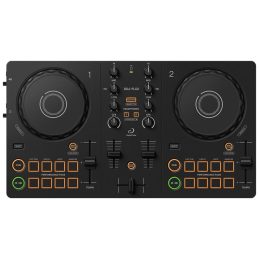
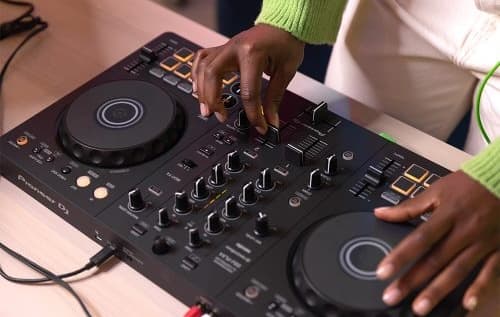 The controller is the star of the whole setup, giving you two decks, mixer controls, jog wheels, faders, EQ and cue buttons, all in one interface. Most current beginner controller mixers have the audio interface for sending the master mix to your laptop speakers or powered speakers while you preview the next track through headphones via the cue button.
Controllers are the perfect solution for both beginners and even more competent DJs, saving you thousands of dollars compared to club-standard CDJ & DJM setups or a classic vinyl turntable-mixer setups.
For a deeper comparison, read our best DJ controllers for beginners guide.
Browse DJ City’s two-channel DJ controllers.
2. A compatible laptop or computer
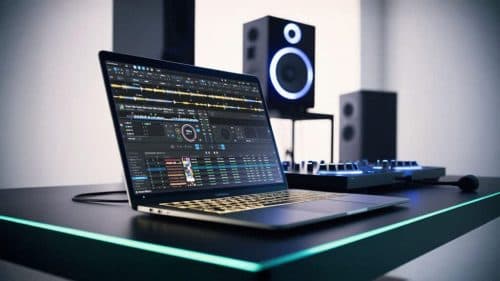 Your computer’s role is to run the DJ software, allowing you to accesses your music library. It’s important to check what USB port your computer uses, since USB-A, USB-B and USB-C are different connector shapes, and the supplied cable may not fit both devices.
3. DJ software
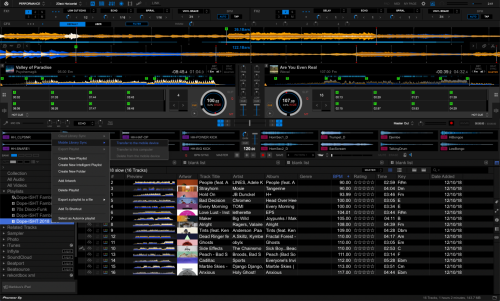 Choose the controller and software together. Entry-level hardware may unlock software such as rekordbox or Serato DJ Lite, but it will not necessarily support every DJ application or every paid feature. Download the supported version from the publisher, then test the controller before an important event.
Browse DJ software at DJ City.
4. Wired DJ headphones
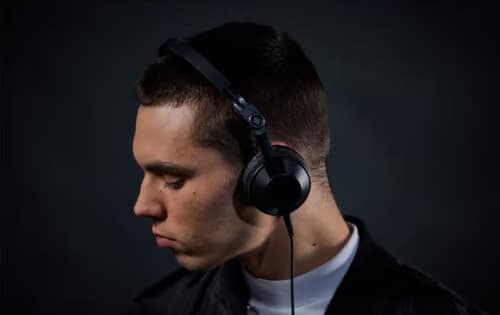 DJ Headphones let you cue the next track without sending it to the speakers. Plug them into the controller’s Phones output, not the laptop. Check whether the socket is 3.5 mm or 6.35 mm and add the correct adaptor if required. Wired headphones avoid the delay associated with Bluetooth audio.
5. Powered speakers
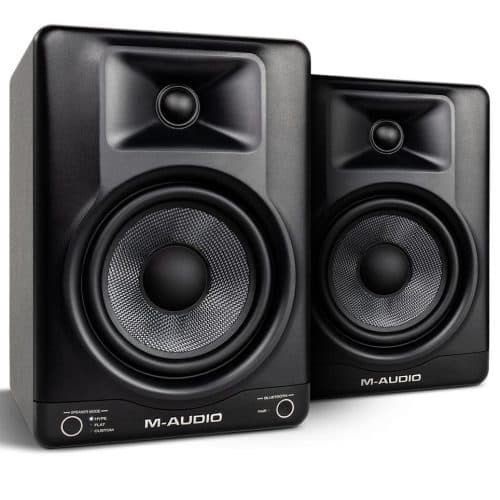 Compact powered speaker monitors, specifically studio monitors, are the simplest choice for bedroom practice because the amplifier is built in. Passive speakers need a separate amplifier. For a party or mobile gig, use powered PA speakers designed for a larger room rather than expecting desktop monitors to cover the space.
Browse studio monitors or browse powered DJ speakers.
6. Audio cables
You’ll need an audio cable that matches the Master output on your controller and the input on your powered speakers. Entry-level controllers and compact studio monitors commonly use a stereo RCA cable. Controllers, mixers and powered PA speakers with balanced outputs and inputs may use XLR cables, especially for longer cable runs. Check both pieces of equipment before ordering because the connectors can differ.
7. Music you know
Start with 10 to 20 tracks you genuinely enjoy and know well. Local MP3, AAC, WAV, AIFF or FLAC files provide a dependable practice library. Streaming support varies by software, hardware, service and region, so check the current terms and keep a local fallback.
Two complete DJ packages for beginners
Why buy everything separately when you can get it all in a single pack? No worries DJ City has you covered! We’ve made the choice super easy for you and narrowed it down to two options:
Our main recommendation
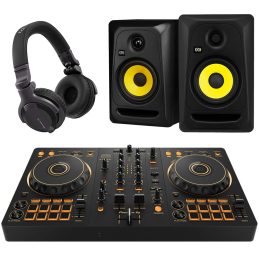
Pioneer DJ PK-DDJFLX4 Complete DJ Pack
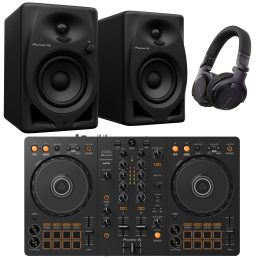
 The Pioneer DJ PK-DDJFLX4 Complete DJ Pack combines a DDJ-FLX4 controller, DM-40D powered monitors and HDJ-CUE1 wired headphones. It suits a beginner who wants a conventional two-channel layout and a complete bedroom system.
- Connect the FLX4 to a USB-C computer with its supplied USB-C cable.
- Connect the FLX4 Master RCA output to the DM-40D RCA input with a stereo RCA-to-RCA cable.
- The PK-DDJFLX4 bundle does not currently include an RCA cable interconnect, so you’ll have to add this to your purchase.
Lower-cost complete kit
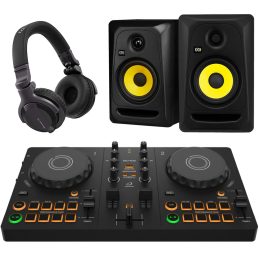
Hercules HERC-DJKIT DJ Starter Kit
 The Hercules HERC-DJKIT includes a DJControl Starlight compact pocket controller, DJMonitor 32 powered speakers, HDP DJ M40.2 headphones and Serato DJ Lite DJ software for both PC and Mac.
- This pocket-sized controller is great for mobile DJs that value portability and has separate 3.5 mm master and headphone outputs.
- It also includes a 3-metre 3.5 mm-to-dual-RCA cable for connecting the controller to speaker monitors.
- Use the supplied USB cable and check whether your computer needs a USB adaptor.
Browse all DJ packages if you need a different controller, software ecosystem or speaker size.
USB-A, USB-B and USB-C connections explained
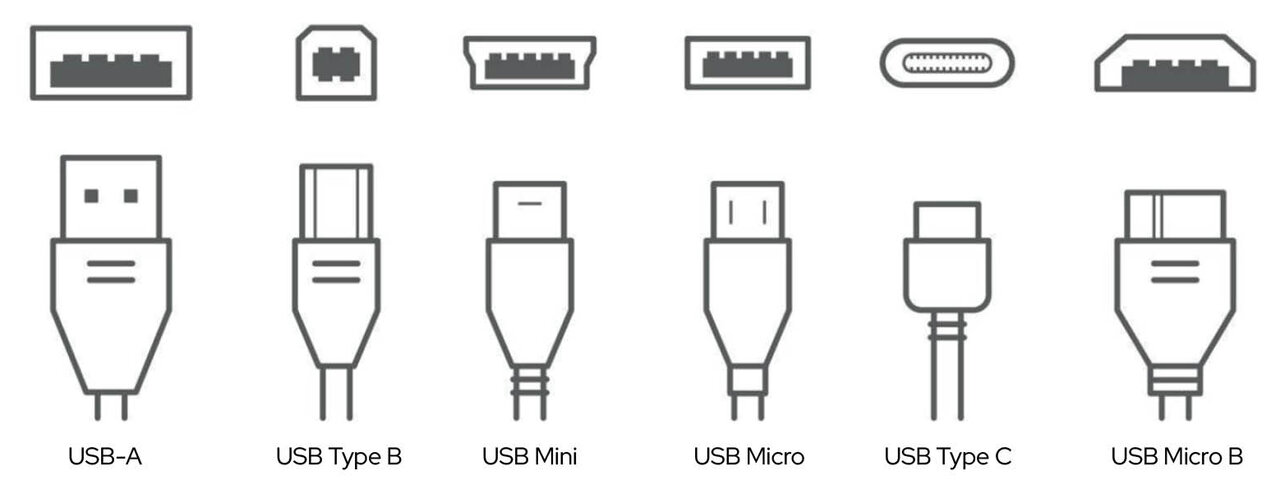 The letter describes the connector shape, not automatically its speed or power capability. Check both ends of the required cable, and make sure it carries data rather than charging only.
| Connector | What it looks like | Where you may find it | Common DJ cable |
|---|---|---|---|
| USB Type-A | Large, flat, rectangular plug that only inserts one way. | Many Windows PCs, older MacBooks and powered USB hubs. | Type-A to Type-B or Type-A to Type-C. |
| USB Type-B | Squarer plug with bevelled upper corners. | The device side of many older controllers, mixers and audio interfaces. | Type-A to Type-B, or Type-C to Type-B for a newer computer. |
| USB Type-C | Small, rounded and reversible. | Newer laptops, tablets, phones and controllers such as the DDJ-FLX4. | Type-C to Type-C, or Type-A to Type-C for an older computer. |
RCA and XLR speaker cables explained
 Start at the controller’s Master output, then match it to an input on the powered speakers. You usually need a left and right connection for stereo.
| Connection | Typical use | What beginners should know |
|---|---|---|
| RCA | Red and white left/right connections on entry-level controllers and desktop monitors. | RCA is unbalanced. It is practical for a short bedroom cable run. The FLX4 uses RCA for its Master output. |
| XLR | Three-pin locking connection on professional controllers, mixers and powered PA speakers. | XLR is normally balanced and better at rejecting interference over longer runs, provided both the output and input are balanced. |
| 6.35 mm TRS | Balanced line outputs or speaker inputs on some equipment. | TRS can carry balanced mono audio, but a TRS headphone plug carries stereo instead. Check the manual rather than judging by the plug alone. |
| 3.5 mm stereo | Compact controllers, laptops and consumer speakers. | A 3.5 mm-to-dual-RCA cable splits stereo into separate left and right RCA plugs. The Hercules kit includes this cable. |
Shop the connection that matches your equipment: RCA cables, XLR cables and RCA-to-XLR cables.
How to connect your first DJ setup
Step 1: Install Your DJ Software and Drivers
Before plugging in any hardware, prepare your laptop. Go to the website of your chosen DJ software (like Serato, Rekordbox, or VirtualDJ) and download the latest version.
Crucial Step: Check your controller manufacturer’s website (e.g., Pioneer DJ, Numark) for specific hardware drivers or firmware. Some controllers need a dedicated driver on Windows, while others work without one. macOS users may also need to grant the software the relevant security permissions.
Step 2: Connect the Controller to Your Laptop
Use the provided USB cable to link your DJ controller to your computer.
- Direct Connections Only: Always plug directly into your laptop’s built-in USB ports. Avoid unpowered USB hubs, as they often fail to deliver enough electrical current to power the controller’s internal audio interface and lights.
- Booting Up: Once connected, your controller should go through a brief light sequence, indicating it is receiving power and communicating with your laptop.
Step 3: Link Your Speakers (Master Output)
Look at the back of your DJ controller for the section labelled MASTER OUT. This sends the main audio mix to your speakers. Depending on your gear, you will use one of two connections:
- RCA Cables (Red and White): Standard for beginner controllers and entry-level studio monitors. Match the red plug to the red socket and white to white.
- XLR or 1/4-inch TRS Cables: Found on pro-level gear. These are “balanced” cables, meaning they reject electrical hum and wireless interference over long distances.
Connect the other end of these cables to the INPUT ports on the back of your powered speakers. Turn the physical volume knobs on the back of your speakers to roughly 50%.
Step 4: Plug in Your Headphones
Locate the headphone jack on your controller. It is almost always on the front edge facing you, though occasionally found on the top panel.
- Jack Sizes: Controllers use either a small 3.5mm (minijack) or a large 1/4-inch jack. Ensure you have the correct adapter handy if your headphone cable doesn’t match.
- Do Not Plug Into the Laptop: Never plug your headphones into your laptop’s headphone jack. They must connect directly to the controller so you can use the hardware “Cue” buttons to preview upcoming tracks.
Step 5: Power Up and Set Your Gain Staging
To protect your speakers from loud audio pops, always turn your gear on in this exact sequence: Laptop ➔ Controller ➔ Speakers. (When turning off, do the exact reverse).
Launch your DJ software, load a track onto Deck 1, and press play. To hear audio, ensure your physical mixer levels are set correctly:
- Turn up the Trim/Gain knob for Channel 1 until the software meters bounce into the green/yellow zone (avoid the red).
- Raise the vertical Channel Fader for Channel 1.
- Keep the Crossfader parked dead-center.
- Slowly turn up the main Master Volume knob on your controller until you reach a comfortable listening volume.
If Deck 1 stays on the speakers while Deck 2 plays privately in your headphones, your master and cue routing is working.
Quick troubleshooting
| Problem | Check this first |
|---|---|
| Controller not detected | Connection failures are usually caused by faulty USB cables, a lack of power, or missing manufacturer drivers. Follow this quick checklist to fix the connection:
|
| No speaker sound | Open your DJ software (e.g., Serato, Rekordbox, VirtualDJ) settings and set the Audio Output Device directly to your DJ controller instead of your computer speakers.
|
| No headphone cue |
|
| Only one speaker works | Reseat the left and right plugs, check the speaker-link cable and confirm that software output is set to stereo. |
| Hum or interference | Speaker hum is usually caused by ground loops, poor cable shielding, or nearby electrical interference. Follow this quick checklist to fix the noise:
|
Frequently asked questions
Can I DJ with only a laptop and controller?
Yes, if the hardware and software support sending the master mix through the laptop speakers. Add wired headphones for proper cueing. Powered monitors make it easier to hear and practise the room mix.
What cables connect a DDJ-FLX4, MacBook and DM-40D speakers?
Use the supplied USB-C cable for a USB-C MacBook. A USB-A Mac needs a certified USB-A-to-USB-C data cable no longer than 3 metres. Connect the FLX4 Master output to the DM-40D RCA input with a stereo RCA-to-RCA cable, then plug headphones into the FLX4.
Should I use RCA or XLR for DJ speakers?
Use the connection supported by both ends. RCA suits a short home connection from an entry-level controller such as the FLX4. Use balanced XLR or TRS when both the controller or mixer output and speaker input support it, especially for longer runs.
Do I need speakers to start DJing?
Not necessarily. Some setups support laptop-speaker output or headphone-only practice. Powered speakers are still useful for learning how the master mix sounds in a room.
Can I use Bluetooth speakers or headphones?
We recommend wired audio for normal DJ cueing. Bluetooth can add delay, and some controller and mobile combinations send audio through the mobile device instead of the controller’s master and headphone outputs.
Can this setup play vinyl records?
Not directly. The FLX4 and Starlight setups above do not accept a turntable. Mixing records requires a turntable plus suitable phono inputs on a mixer or controller. DVS also requires compatible hardware, software and control vinyl.
Your next step
Choose a controller package that works with your computer and preferred software, check every port before ordering cables, then follow the connection test above. Once you can hear one deck through the speakers and cue the other in your headphones, continue with our complete guide to learning how to DJ.
Further reading
Related DJ City guides
- Best DJ Controller for Beginners: DJ City’s Top Picks in 2026
- How to DJ: The Complete Beginner to Expert Guide
- DJ Controller vs Turntables vs CDJs: Which Setup Is Best?
- Vinyl DJing 101
- How to DJ beginner setup video
Technical sources
- AlphaTheta support: DDJ-FLX4 computer, USB, speaker and headphone requirements
- AlphaTheta support: DM-40D inputs and connections
- Hercules: DJStarter Kit product information and included cables
- Focusrite: Balanced and unbalanced audio connections
- USB-IF: USB Type-C cable and connector specification
- Serato: Using laptop speakers as the master output