What Is a Phono Preamp and Do You Need One? (2026)
So you’ve unboxed your new record player, plugged it into your speakers, dropped the needle and… no sound. Or, you do get an output signal, but it’s loud, harsh and distorted. Nine times out of ten, the culprit is the phono preamp: you’re either missing one or doubling up on the one that’s already built into your turntable. In this guide, we’ll explain what a phono preamp is, what it actually does, how to tell whether your setup already has one, and what to look for if you need a separate one.
Disclosure: DJ City sells some of the products mentioned in this guide. This article is based on current product information and manufacturer documentation, not hands-on testing.
What does a phono preamp do?
A phono preamp, or phono stage, is a small amplifier that boosts a turntable’s very quiet phono-level signal to line level and applies RIAA equalisation, so records play at normal volume with the right bass and treble balance.
It has two jobs, and your records won’t sound right unless both happen:
1. It raises the signal to line level
Your cartridge makes a tiny electrical signal as the stylus traces the groove. Audio-Technica puts a typical cartridge output at around 0.005 volts, known as phono level. Most amplifier inputs and powered speakers expect line level, which Audio-Technica puts at about 0.3 volts. The preamp makes up that gap. Without it, you’ll hear something very quiet and thin, even with the volume cranked.
2. It applies RIAA equalisation
Since the 1950s, records have been cut using the RIAA equalisation curve, which reduces the bass and boosts the treble so more music fits in the groove (this is because records aren’t cut with a flat frequency response). On playback, the phono preamp does the exact opposite: It restores the curve to its original balance. That’s why you can’t just plug a turntable into any old input and turn it up: even if it got loud enough, it would sound bright and bass-light.
Phono preamp versus power amplifier
These are different jobs. The phono preamp gets the signal to line level and corrects the EQ. The power amplifier then drives the speakers. Powered, or active, speakers have the power amp built in; passive speakers need a separate amplifier or receiver.
If you’re curious about where the phono stage sits among all the other parts of a turntable, our guide to turntable components breaks it down part by part.
Do you need a phono preamp for your turntable? Three quick checks:
You always need a phono preamp somewhere in the chain, but how do you know if you already have one? Work through these three checks in order:
Check 1: How to tell if your turntable has a built-in preamp
Look at the back of your turntable for a switch labelled PHONO/LINE. If there is one, your turntable has a built-in preamp, and the switch turns it on or off. Many beginner and Bluetooth record players, including the Audio-Technica models in our best record players for home listening guide, have one. Some manual hi-fi decks and professional DJ turntables only output phono level, so they need a preamp elsewhere. If there’s no switch, check the manual or the product page for “built-in phono preamp” or “phono-level output only”.
Check 2: Does your amplifier or receiver have a PHONO input?
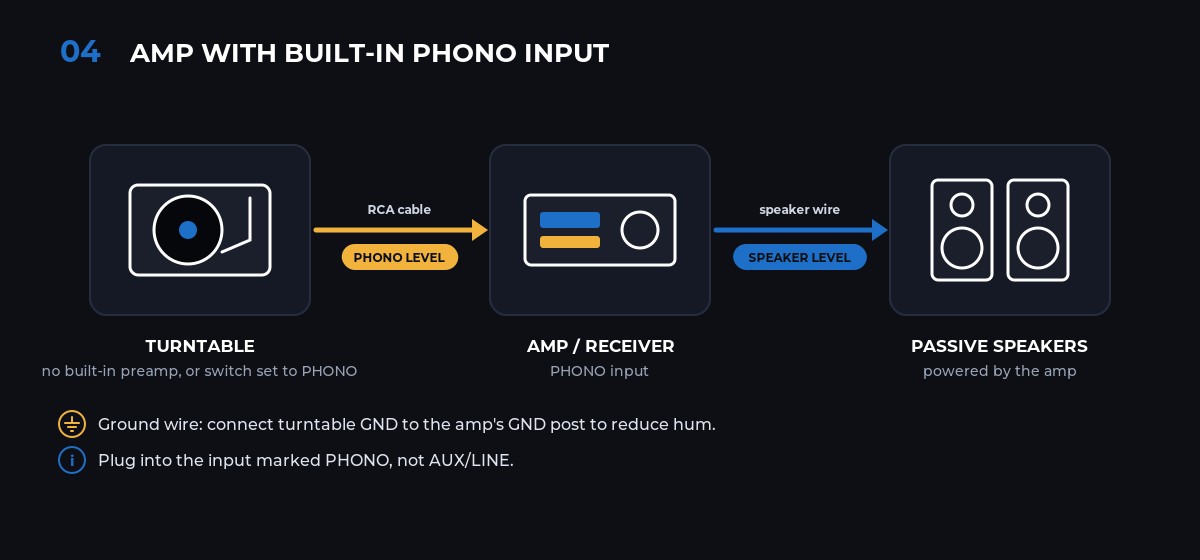
If you’re using passive speakers with an amplifier or receiver for your turntable, look for an input labelled PHONO, usually with a ground terminal beside it. That input has its own phono preamp, whereas inputs with AUX, CD, LINE or TAPE labels do not.
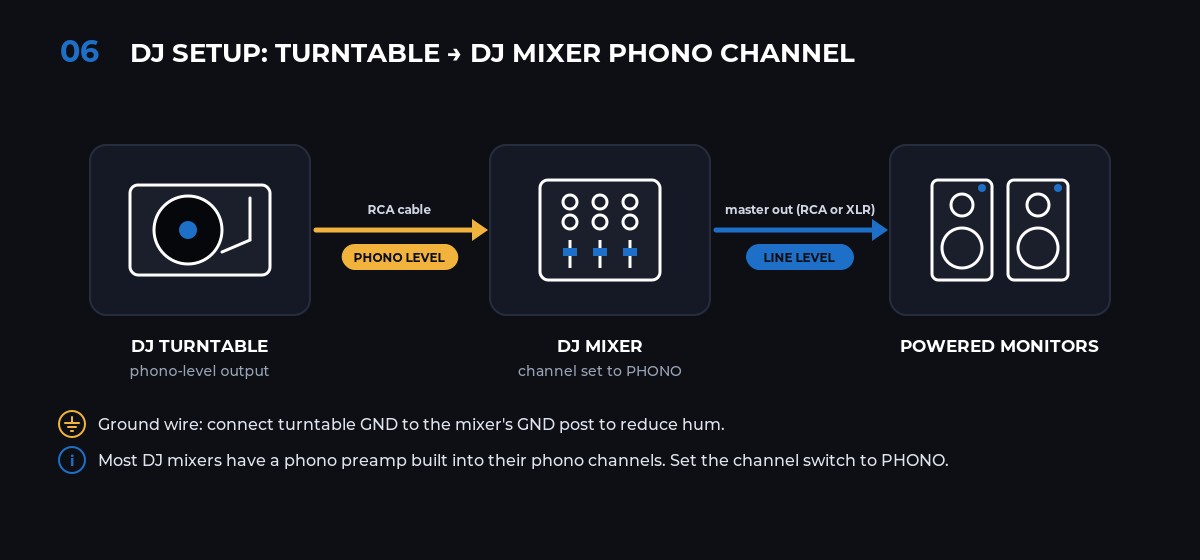
Check 3: Are you plugging into a DJ mixer?
Most DJ mixers have phono channels with preamps built in, often with a PHONO/LINE switch per channel. If you’re running turntables into a mixer with phono inputs, you don’t need anything extra. For a full turntable DJ rig, our essential gear for turntable DJs guide covers what else belongs in the signal chain.
The short version
- Turntable has a PHONO/LINE switch? Use its built-in preamp when you need line-level output.
- Amp or receiver has a PHONO input? Send it a phono-level signal.
- DJ mixer has a phono channel? Use that channel for a phono-level turntable.
If the answer to all three is no, you need a separate phono preamp.
Phono vs line: the PHONO/LINE switch, explained
This little switch causes more confusion than anything else on a record player, so here’s the rule:
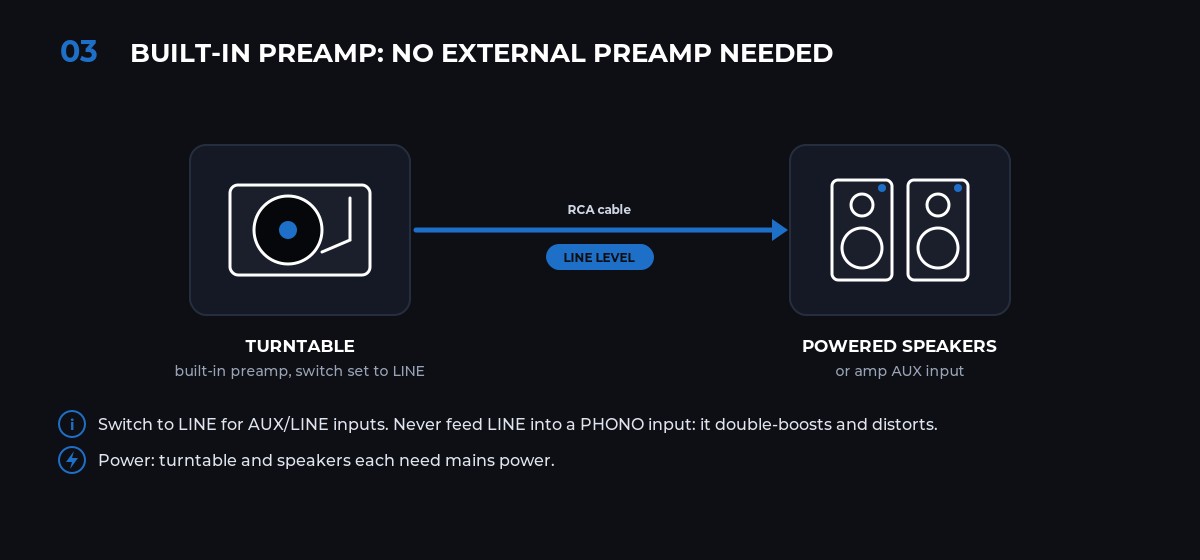
- LINE turns the turntable’s built-in preamp on. Use it when you connect to powered speakers, or to an AUX, CD or LINE input on an amplifier.
- PHONO turns the built-in preamp off. Use it when you connect to an amplifier’s PHONO input, a DJ mixer’s phono channel, or a separate phono preamp.
The double-preamp mistake
If your turntable is set to LINE and it’s plugged into a PHONO input, the signal gets boosted and equalised twice. Audio-Technica warns this makes the signal too hot, which distorts the sound and could potentially damage your amplifier or speakers. Typical symptoms are harsh, crunchy or overly boomy playback.
The missing-preamp mistake
The opposite problem happens when the turntable is set to PHONO and plugged into a line-level input such as AUX or powered speakers. There’s no preamp anywhere, so the music is very quiet, even with the volume turned right up.
How to connect your turntable
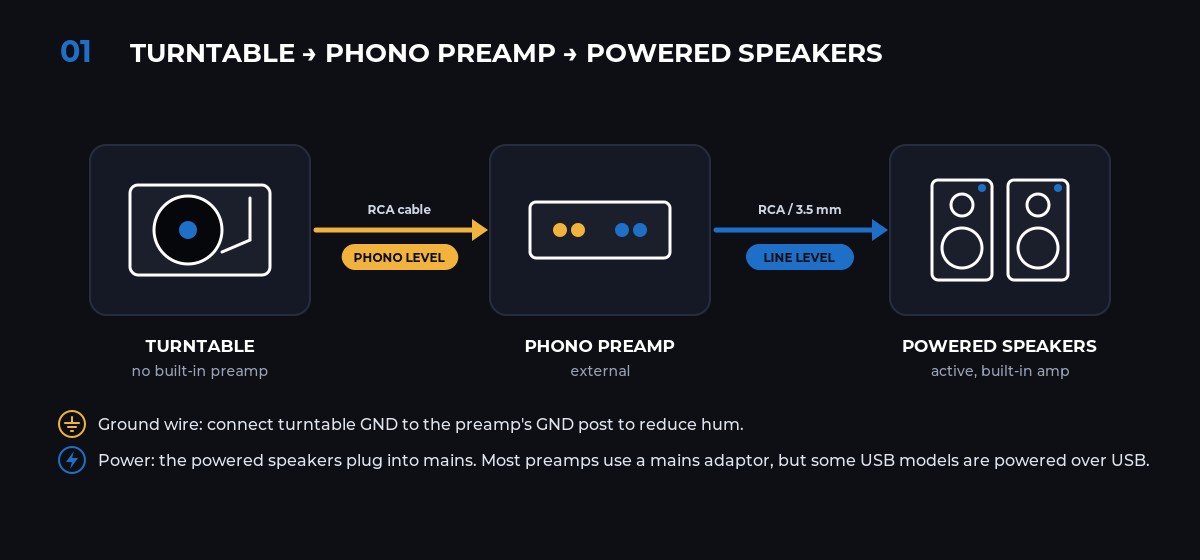
Turntable to powered speakers
For the simplest home setup: If your turntable has a built-in preamp, set it to LINE and run RCA cables straight into the powered speakers’ line or AUX input. If it doesn’t, put a phono preamp between the two: turntable into the preamp’s input, preamp’s output into the speakers.
One thing to note: Most powered speakers don’t include a phono preamp, so check the speaker’s inputs before you assume it does.
Turntable to an amplifier and passive speakers
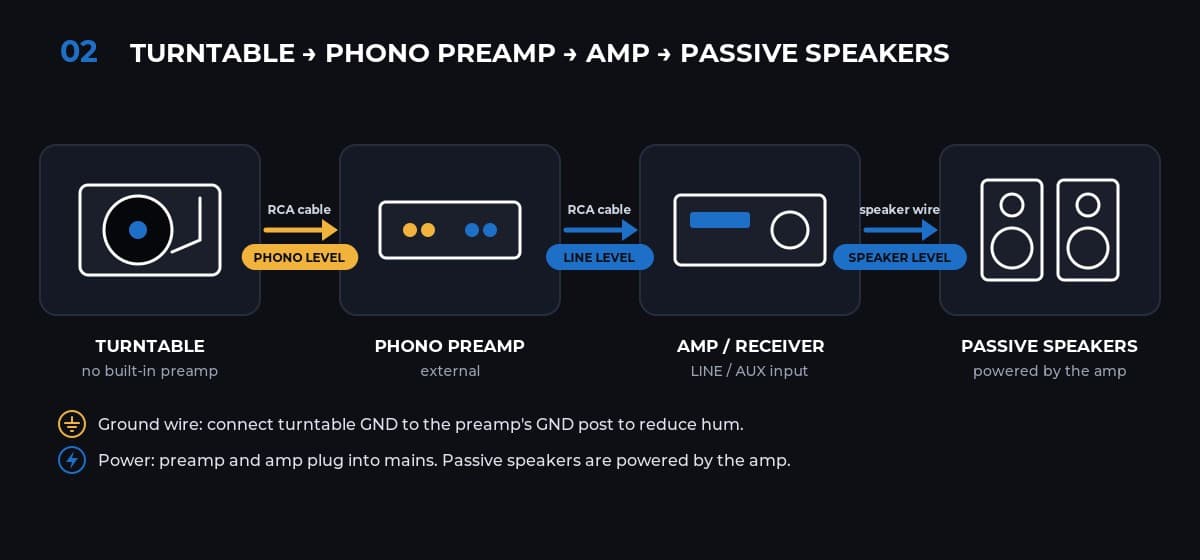
If your amp has a PHONO input, set the turntable to PHONO, or use a phono-only deck, and plug into it. If your amp only has line inputs, either switch the turntable to LINE or add a phono preamp before the amp’s AUX input.
Bluetooth turntables
Bluetooth speakers and headphones don’t have phono preamps, so Bluetooth turntables use their built-in preamp to send the signal. Audio-Technica notes that its Bluetooth models need the switch on LINE for Bluetooth to work.
Recording vinyl to a computer
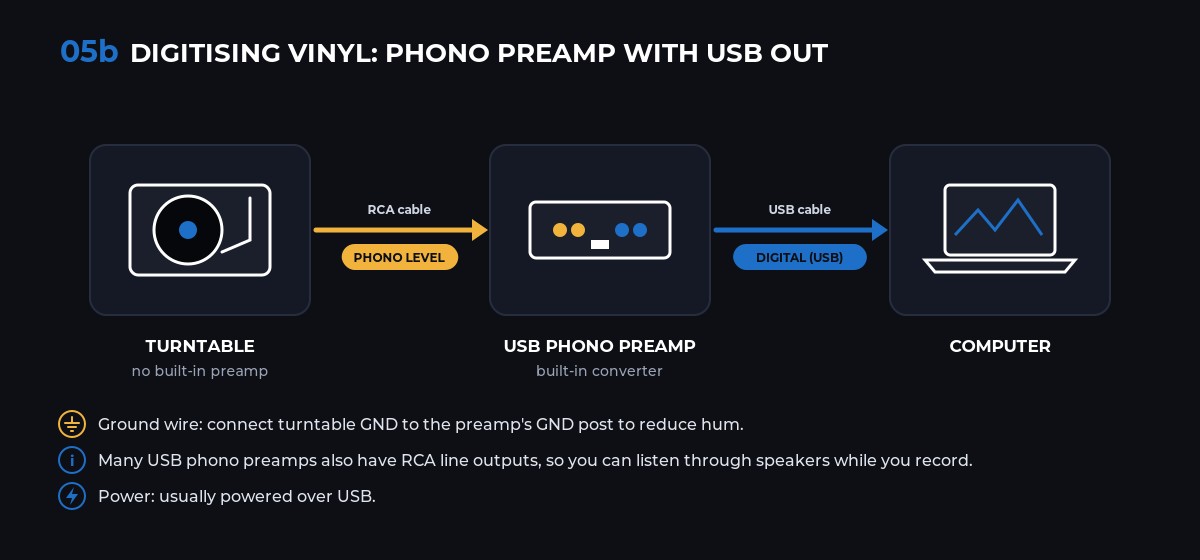
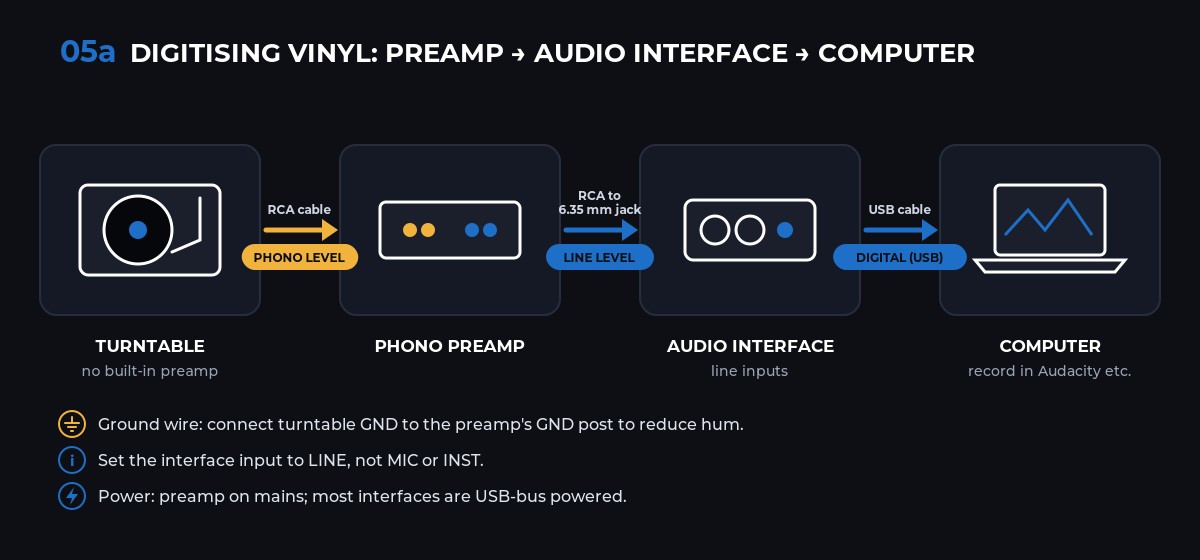
To digitise your records, the signal needs a phono preamp and a converter before it reaches your computer. A USB phono preamp does both in one box. If you already own an audio interface, put a phono preamp in front of it and plug into the interface’s line inputs. Our guide on how to record vinyl to your computer covers the software side.
Grounding and hum
Many turntables have a thin ground wire that connects to a ground terminal on the preamp, amplifier or mixer. If you hear a low hum, check the ground connection first. Audio-Technica suggests trying playback with and without the ground connected and keeping whichever is quieter, as some setups with an external power supply may not need it.
When is an external phono preamp worth it?
Even if your record player has a preamp built in, there are good reasons to add a separate turntable preamp:
- Your turntable is phono-level only. Many manual hi-fi decks and pro DJ turntables send phono-level output only, so you need a preamp somewhere if your amp, speakers or mixer can’t take phono level.
- Your amp has no PHONO input. Many modern amplifiers, soundbars and studio monitors don’t include one, so a stand-alone record player preamp fills the gap.
- You’re using a moving coil cartridge. MC cartridges produce an even lower output than the more common moving magnet type, so they need a preamp with more gain and MC support. Check your cartridge type before you buy.
- You want to digitise your records. A USB phono preamp combines the preamp with an audio interface, so you can record vinyl straight to your computer. Our guide on how to record vinyl to your computer walks through the process.
- You’re connecting a turntable to pro audio gear. For mixing consoles, PA systems and recording interfaces, a preamp with balanced outputs makes long cable runs and pro inputs easier.
- You want to bypass your turntable’s built-in stage. Switching the turntable to PHONO lets you send its signal to a separate preamp instead. Whether that makes an audible difference depends on your system, so treat it as an optional upgrade rather than a must-have.
Choosing a phono preamp
If you do need a separate one, start with what your setup needs rather than the price tag. For a phono-only turntable going into powered speakers or an AUX input, a simple box such as the Behringer PP400 does the job. If you want to record your records, look for a USB phono preamp like the ART USB Phono Plus PS. Moving coil cartridges need a preamp with MC support, such as the ART Precision Phono Pre, and for PA or studio rigs, you should look for balanced outputs like those on the Radial J33 to make your life a lot easier.
You can see the full range in our phono preamps collection.
What else you might need
- RCA cables to connect the turntable, preamp and speakers or amplifier.
- Powered speakers, or an amplifier and passive speakers. See powered speakers and home hi-fi packages.
- A record player, if you’re still choosing one. Our best record players for home listening guide is a good starting point, and the turntable buying guide explains drive types and features.
- A compatible cartridge, if you’re upgrading. Check whether it’s MM or MC before you choose a preamp. See our turntable cartridges.
Frequently asked questions
What does a phono preamp do?
It boosts the very low signal from a turntable’s cartridge up to line level and applies RIAA equalisation, so records play back at a normal volume with the correct bass and treble balance.
Do I need a preamp for my turntable?
Yes, somewhere in the signal chain. Many turntables, amplifiers with PHONO inputs and DJ mixers already have one built in. You only need to buy a separate preamp if none of your gear has one, or if you want features like MC support, USB recording or balanced outputs.
Does a vinyl player need a preamp?
Yes. Every vinyl player needs a phono preamp somewhere in the chain. It can be built into the player itself, into your amplifier’s PHONO input or a DJ mixer’s phono channel, or be a separate box between the player and your speakers or amp.
Do I need a preamp and an amp for my turntable?
You need a phono preamp and amplification. Powered speakers have the amplifier built in, so a turntable with a built-in preamp set to LINE can plug straight in. Passive speakers need a separate amplifier or receiver, plus a phono preamp in the turntable, the amp’s PHONO input or a separate box.
What is a phono stage?
A phono stage is another name for a phono preamp. It raises the cartridge’s phono-level signal to line level and applies the RIAA equalisation needed for records to sound balanced. “Preamp” is the broader term, while “phono stage” describes the part made specifically for a turntable.
What is an external phono preamp?
It’s a separate box that sits between your turntable and your amplifier or speakers. You’d use one when nothing in your setup has a phono preamp built in, or when you want features like moving coil support, USB recording or balanced outputs.
Is a phono preamp the same as a preamp?
Not exactly. “Preamp” is a general term for any stage that boosts a signal before the power amplifier, such as a microphone preamp. A phono preamp is a specific type that also applies the RIAA equalisation curve needed for vinyl.
Is a phono preamp the same as an amplifier?
No. A phono preamp boosts the turntable’s tiny signal to line level and applies RIAA equalisation, but it can’t drive speakers on its own. An amplifier, built into powered speakers or as a separate unit for passive speakers, does that job. Some amplifiers include a phono preamp, shown by an input labelled PHONO.
Which phono preamp should I get?
It depends on your setup: a basic box for a phono-only turntable, a USB model for recording, MC support for moving coil cartridges, or balanced outputs for PA and studio rigs. See choosing a phono preamp above.
Why is my turntable so quiet?
Usually there’s no phono preamp in the chain. The turntable may be set to PHONO and plugged into a line-level input such as AUX or powered speakers. Switch it to LINE if it has a built-in preamp, or add a separate phono preamp.
Why does my turntable sound distorted or boomy?
You may be using two preamps at once, for example a turntable set to LINE plugged into an amplifier’s PHONO input. Switch the turntable to PHONO, or move the cable to a line-level input.
Can I plug a turntable straight into Bluetooth or powered speakers?
Only if the turntable has a built-in preamp switched on, or you add a phono preamp in between. Bluetooth turntables use their built-in preamp to send the signal.
Do I need to connect the ground wire?
If your turntable has one, connect it to the ground terminal on your preamp, amp or mixer. If you hear hum, check this connection first.
Need a hand?
Not sure whether your setup needs a phono preamp? Chat with the DJ City team or drop into one of our stores to chat with our friendly staff. Tell us what turntable, speakers or amplifier you’ve got, and we’ll help you work out the rest!